CDR Sample for Geotechnical Engineer (ANZSCO 233212)
Use the professional help of our CDR writers to create a high-quality CDR that will guarantee that your geotechnical engineering expertise will pass the stringent evaluation of Engineers Australia.
At A Glance
Geotechnical Engineer CDR Sample (ANZSCO 233212)
- Success-Proven Structure: Enter a detailed CDR framework specifically created to emphasise the technical skills necessary to ensure the competencies of a positive skills assessment of a Geotechnical Engineer.
- 3 Technical Career Episodes: Each episode includes a summary of major projects involved in, like Advanced Soil Stabilisation, Foundation Design of High-Rise Structures and Comprehensive Slope Stability Analysis.
- Industry-Standard Expertise: Showcases proficiency in essential tools like PLAXIS and GeoStudio, alongside mastery of soil mechanics, seismic risk assessment, and site investigation methodologies.
A Brief on Geotechnical Engineer (ANZSCO 233212)
Geotechnical engineers examine the behaviour of soils and rocks in order to design foundations of structures such as dams, bridges, and tunnels. They undertake site investigations, sample tests, and stability against earth pressures and seismic hazards. Geotechnical engineers are categorised as professionals under the civil engineering profession by the Department of Home Affairs.
Statistically, 1,150 Geotechnical Engineers (ANZSCO 233212) are annual recipients of a permanent skilled migration visa. The figure shows the number of professionals who have successfully migrated to Australia with a CDR report under the General Skilled Migration (GSM) program.
Geotechnical Engineer Competency Demonstration Report Sample
A Geotechnical Engineer Competency Demonstration Report Sample consists of 3 Career Episodes, 1 Continuing Professional Development (CPD), a Summary Statement, and a Curriculum Vitae. The sample includes the following material:
Curriculum Vitae
CV formatted with a professional engineering template that is Geotechnical job-specific.
Continuing Professional Development (CPD)
An example CPD report about the technical workshops, seminars and recent experience of the author in the field of soil mechanics and site investigation (about 1000 words).
Geotechnical Engineer Career Episode Report Sample 1
Conducting Comprehensive Site Investigations and Foundation Design of a 50-storey residential complex.
Geotechnical Engineer Career Episode Report Sample 2
Performing Slope Stability Analysis and Ground Improvement Techniques Implementation of a Major Rail Expansion.
Geotechnical Engineer Career Episode Report Sample 3
Analysing Soil-Structure Interaction and Designing Retaining Walls of an Underground Tunnel Project.
Geotechnical Engineer Summary Statement Sample
An overall Summary Statement that links particular paragraphs of the career episodes to the competency elements needed by Engineers Australia (EA).
Geotechnical Engineer Career Episode Samples
The career episodes should be composed in Australian English and your own words, depending on your recent work experience. Every career episode must show the difficulties you encountered in your projects and how you overcame them. Our Career Episode Writers advise to label each of your career episodes with a number as follows: Career Episode 1 (paragraphs 1.1, 1.2, 1.3, etc.), etc. The major projects are as follows:
Project Name: Site Investigation and Foundation Design for a High-Rise
The author explains one of the projects he did when he was pursuing hiBachelor’sor degree in Civil Engineering. This project was named Site Investigation and Foundation Design of a High-Rise. The responsibilities were to:
- Plan and oversee a geotechnical site investigation, including borehole placement and in-situ testing.
- Analyse soil stratigraphy and shear strength using SPT and laboratory test data.
- Calculate the axial and lateral load capacity of deep pile foundations.
- Conduct settlement analysis to ensure compliance with serviceability and safety standards.
- Suggest particular foundation depths and construction techniques to control the risks of the ground.
Skills & Technologies Demonstrated:
- Software: PLAXIS 2D, g INT, AllPile, Microsoft Excel.
- Standards: AS 1726 (Site Investigations), AS 2159 (Piling), Eurocode 7.
- Competencies: Foundation Engineering, Soil Mechanics, Settlement Prediction, Technical Reporting.
Project Name: Slope Stability and Ground Improvement for Rail Expansion
This career episode explains the experience gained during a 6-month industrial training program. Key duties included:
- Carrying out field surveys to determine failure areas along a proposed railway route.
- The analysis of Factor of Safety (FoS) is performed by performing a limit equilibrium analysis at different loads.
- Coming up with ground improvement techniques such as stone columns and vertical wick drains.
- Reinforcement modelling, soil nailing, and geotextiles.
- Planting and monitoring geotechnical equipment, such as inclinometers and piezometers.
Skills & Technologies Demonstrated:
- Software: GeoStudio (SLOPE/W), Slide2 (Rocscience), AutoCAD Civil 3D.
- Standards: AS 4678 (Earth-retaining Structures), RMS Geotechnical Specifications.
- Competencies: Slope Stability Modelling, Ground Improvement, Geotechnical Monitoring, Risk Management.
Project Name: Soil-Structure Analysis and Retaining Wall Design for Tunnelling
The author describes his work in a deep urban excavation consultancy project in this career episode. Responsibilities comprised:
- The use of soil-structure interactions to determine the effects of excavations on nearby structures.
- Planning Diaphragm walls and multi-level anchoring of deep excavations.
- Determining earth lateral pressures to maximise the profiles of retaining structures.
- Possessing a dewatering plan to avoid surface subsidence of cities.
- Communicating with multi-disciplinary teams to achieve high levels of deflection limits.
Skills & Technologies Demonstrated:
- Software: WALLAP, Midas GTS NX (FEA), RS2, AutoCAD.
- Standards: AS 5100 (Bridge Design – Retaining Walls), CIRIA C760.
- Competencies: Finite Element Analysis (FEA), Retaining Wall Design, Groundwater Hydrology, Lateral Pressure Calculation.
Proof of Our Reliability: Positive Skill Assessment
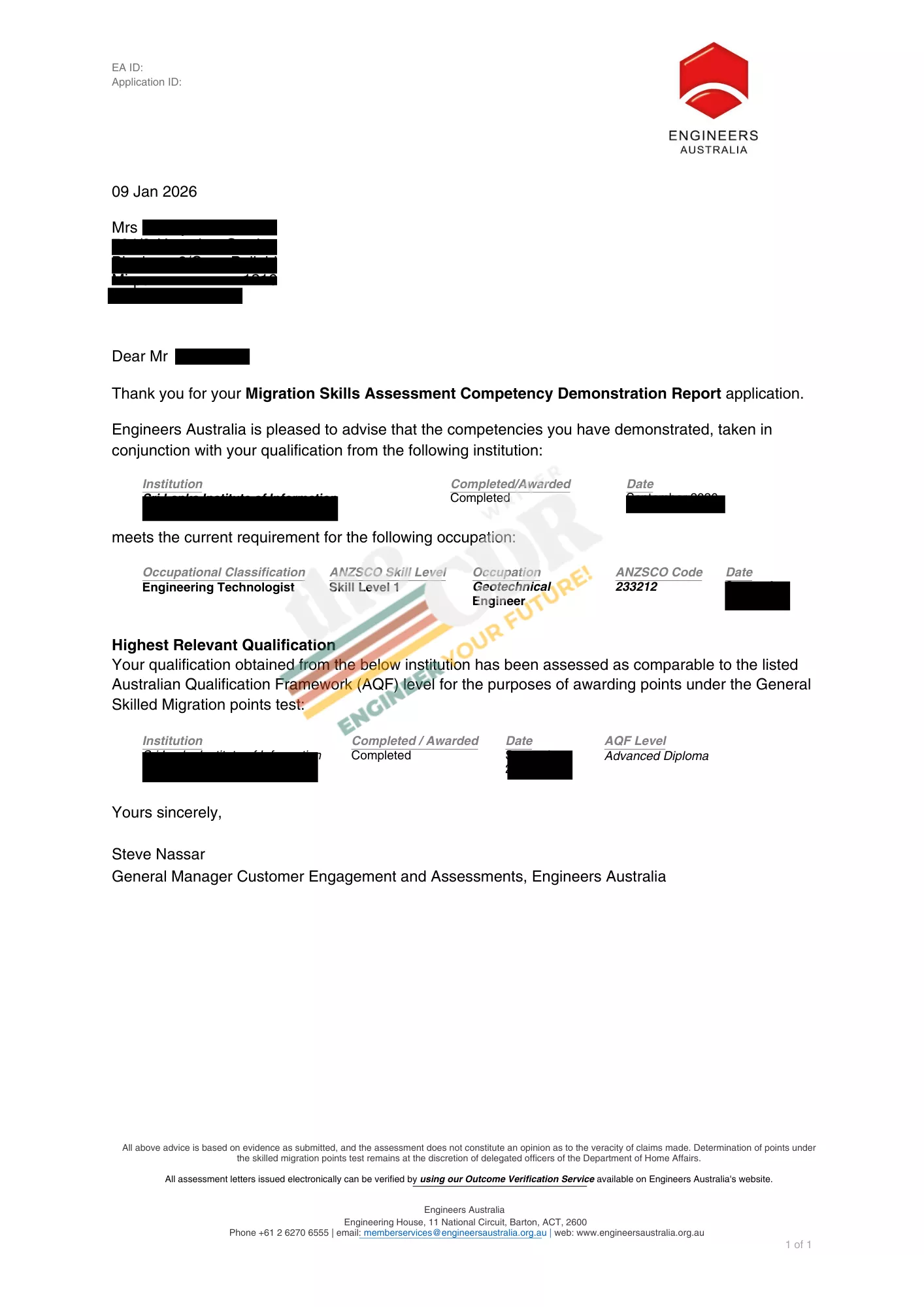
All sections of the CDR, the career episodes, the CPD and the summary statement are meant to attain one thing: a positive outcome letter by Engineers Australia, such as the one shown below. This letter is the key that opens the door to your professional migration journey. You can read the full case study to know in detail.
Check Out More CDR Report Samples
These are the recently approved CDR report samples from our CDR report writing experts.
Why Trust Us?
All our samples are regularly updated and fully aligned with the latest EA and ACS guidelines to ensure accuracy and relevance.

Latest Version
All our samples are up-to-date and maintain the recent EA and ACS guidelines.

Original Content
Each sample is unique and written from scratch by our report-writing experts.

Positive Results
We have gained accolades from clients because of our results-driven samples.

Format & Structure
The samples are written following the authorities' formatting & structuring guidelines.
GET FREE CDR CONSULTATION
Pricing Guide for CDR Writing
More than 7845 People Signed Up for our Writing Guidance! Are You NEXT?
I received great advice from CER Writers during my CDR submission. They addressed all of my inquiries and produced an excellent career episode report Engineers Australia template that complied with all specifications. My skills assessment was accepted on my first attempt and received positive outcomes.
I am very thankful and happy with TheCDRWriter; their personalised approach and expert advice were flawless. I received positive outcomes from EA on the first attempt.