
Do you plan to migrate to Australia as an Industrial Engineer and feel overwhelmed by the career episode writing process? A career episode for industrial engineer presents a detailed narrative that showcases your engineering competencies and practical experience to Engineering Australia for skill assessment under ANZSCO 233511.
You must submit a CDR report for the evaluation process. CDR comprises three career episodes, a summary statement and a CPD (continuing professional development) report. You need to follow specific instructions to write the career episode, and in this guide, you will get the guidance to write CDR career episodes for Industrial engineers.
Key Takeaways
- Three career episodes are required, which cover different projects or aspects of your Industrial Engineering work.
- Write in the first-person narrative.
- Each career episode should have 1000-1200 words.
- You must follow the prescribed structure given by Engineers Australia.
- Your industrial engineer career episode report must be plagiarism-free.
What Is an Industrial Engineer Career Episode for Engineers Australia?
A career episode is a detailed written account of a specific engineering project, assignment, or period of work that shows your competencies as an Industrial Engineer. According to Engineers Australia’s Industrial Engineer CDR guidelines, around 75% of skilled Industrial Engineer migration applications to Australia require Career Episode revisions due to insufficient detail or improper formatting.
For ANZSCO 233511, these competency reports must prove your ability to design, develop, and improve integrated systems involving people, materials, information, equipment, and energy.
Engineers Australia (EA) asks for a CDR report, which includes three career episodes as the primary evidence to assess whether your qualifications and experience align with Australian engineering standards. Each episode should highlight different aspects of your engineering knowledge and showcase how you have applied theoretical concepts to practical situations. This also involves your communication skills.
Understanding ANZSCO 233511 Career Episode
Before you write your career episode report for industrial engineering, you should understand what CDR ANZSCO 233511 is.
According to the ANZSCO definition, an Industrial Engineer:
“Investigates and reviews the utilisation of personnel, facilities, equipment and materials, current operational processes and established practices to recommend and implement changes to optimise efficiency, productivity and overall performance.”
When you write your career episodes for CDR Australia, make sure your task descriptions are aligned with the core responsibilities. Engineers Australia evaluates whether your experience matches the ANZSCO 23511 code description, so you must show how you have performed the specific industrial engineering functions throughout your career.
How Do Your Write an Industrial Engineer Career Episode for ANZSCO 233511?
Writing a successful career episode format Engineers Australia (EA) requires careful planning and attention to detail. Make sure your career episode writing services follow them. Here’s a step-by-step approach that you should demonstrate in your content:
1. Select Appropriate Projects
Choose three different projects that show your diverse knowledge and work experience in that industry. Consider projects such as:
- Process optimisation initiatives you led
- The production planning and control system that you designed
- Quality management implementations you executed
- Ergonomics assessments you conducted
2. Follow the Required Structure
Introduction (50-100 words)
Mention your project title and duration in the content along with your organisation name, location and specify your designation and role in the project.
Background (200-500 words)
Explain the project context and business environment, describe the organisational structure, and define the project scope and objectives. List the resources you had and clarify your specific responsibilities.
Personal Engineering Activity (700-1500 words)
This section forms the heart of your career episode. You must include:
- Engineering problems you identified.
- What analysis methods did you use?
- Solutions that you got and implemented.
- Challenges that you faced and overcame.
- Ways you collaborated with team members.
- Summary Statement Writing (50 words).
- Recall your key contributions and highlight them in your summary statement, which you showed when completing your project.
- Use First-Person Active Voice.
- Every career episode should show your individual contributions, as it directly showcases your knowledge and experience. Make sure that you use phrases like: “I designed…”, “I analysed…”
- Completely avoid passive words like “it was decided” or “the team implemented.”
Career Episode Examples Industrial Engineer
Here are some career episode examples for an Industrial Engineer Career Episode Sample:
- Implementation of Lean Manufacturing System in the Assembly Line
- Design and Optimisation of Production Layout for Furniture Factory
- Reduction of Setup Time Using SMED Methodology
- Capacity Planning and Production Scheduling for Textile Mill
- Root Cause Analysis and Corrective Action for Product Failure
What Common Mistakes Should You Avoid in Industrial Engineer CDRs?
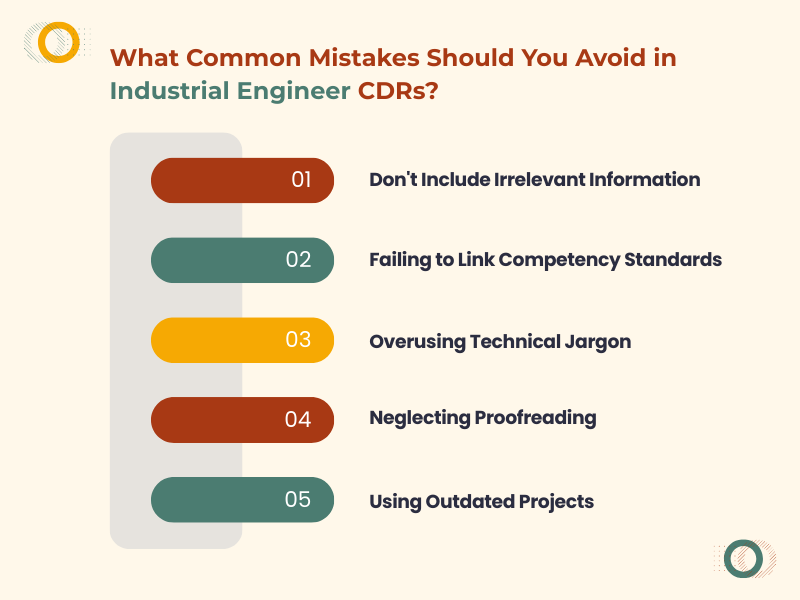
If you don’t want to get rejected, avoid these common mistakes, which can weaken your career episode:
Don’t Include Irrelevant Information
They don’t want to see excessive company history or a lengthy background on team members. This just wastes your valuable word count and dilutes your engineering narrative.
Failing to Link Competency Standards
Each career episode should show some specific competencies from Engineers Australia’s (EA) Stage 1 competency standards. When you randomly describe projects without strategic competency alignment, you weaken your application.
Overusing Technical Jargon
While technical accuracy is a requirement, incomprehensible jargon can confuse the authority. You must balance technical terminology specifications with clear explanations that show your understanding.
Neglecting Proofreading
You must check the typos, formatting inconsistencies, and grammatical errors in your document. Use tools like Grammarly, but also have a native English speaker to review your work. If you are unsure about writing the resort, you can choose a domain-specialised professional CDR writer. However, before you do so, do your research and check out the tips for choosing the right CDR expert, about the writer or service provider.
Using Outdated Projects
While the authority accepts older projects, submitting only decade-old experience may raise questions about your current knowledge and skills. You must include recent projects to showcase up-to-date knowledge. Take Industrial Engineer CDR writing help to avoid these silly mistakes.
Conclusion
Writing a compelling career episode for an Industrial engineer requires strategic planning, attention to detail, and authentic representation of your engineering experiences. Remember that your competency demonstration report (CDR report) and career episode writing services should support rather than replace your genuine engineering narrative. With careful preparation and attention to quality, your career episodes can effectively support you in your migration skills assessment and help you fulfil your dream of a great career in Australia.
Avail of our CDR writing services and get complete CDR packages. Not just that, you can go through our sample for an industrial engineering report. You can also check our CDR-related blogs to get more insights into the Industrial Engineers Australia CDR. Our CDR writers are experienced enough to understand your needs and will provide you with the right guidance and strategy, which will get approval
Frequently Asked Questions
Can I use the same project for submitting multiple career episodes?
No, you cannot submit the same project for writing multiple career episodes, as it will increase the risk for rejection. Each career episode should showcase your different competencies.
Is it okay to use the team’s achievements?
No, you cannot use your team’s achievement collectively. Rather, you should highlight your separate contributions in that particular project.
What technical details should I include?
You can mention tools like Minitab, diagrams, or standards, and quantify your achievements with metrics.
What is your process for CDR writing?
Get a free consultation, select the service you need, then pay and share your CV/project/qualification. Then our writers draft EA guidelines, review the quality, and deliver with revisions.

Want To See My Profile — Click Here Iqbal
- How to Write Career Episode for Industrial Engineer- ANZSCO 233511 - January 16, 2026
- 8 Top CDR Writing Services for Engineers Australia in 2026 - December 17, 2025
- Why Is ACS Skills Assessment for PR in Australia Important? - November 29, 2025