
If you’re planning to work as an ICT professional in Australia in 2026, the ACS Skills Assessment is a key step in your migration journey. Many applicants have strong experience but still face rejection due to small, avoidable mistakes in documentation, job role explanation, or report structure. Understanding these mistakes in advance can help you submit a clear, accurate, and well-prepared application. The RPL report rejection has increased to 40 % .
Are you looking for ACS Skill Assessment rejection reasons? Or how to pass ACS Skill Assessment? Want to know what documents are often missed during ACS Skill Assessment submission? Then you are at the perfect place. In this guide, we’ll walk through the Top Errors to Avoid in the ACS Skill Application and how you can avoid them, so your ACS submission has a higher chance of receiving a positive outcome.
Common Mistakes in the ACS Skills Assessment
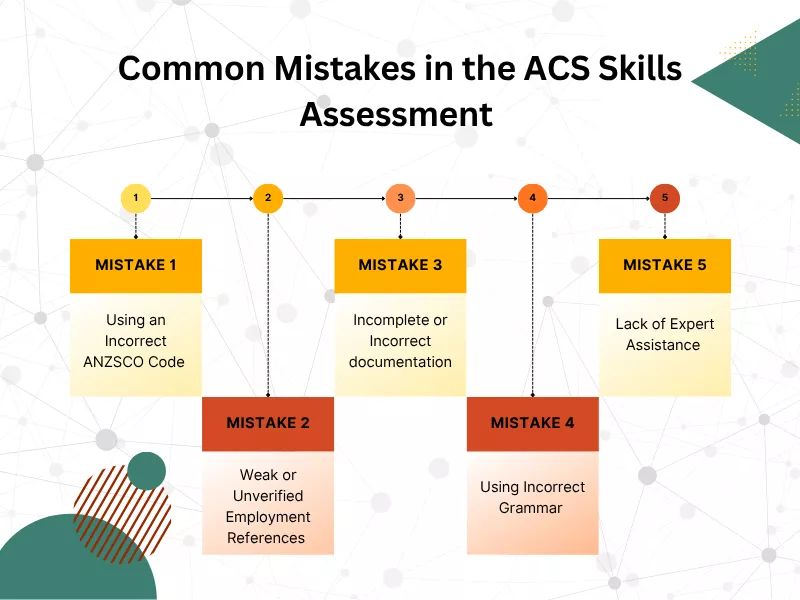
Knowing ACS Skill Assessment mistakes and how to avoid them can make your application smoother and increase your chances of a skilled migration to Australia. Here we will discuss ACS RPL report errors:
Using an Incorrect ANZSCO Code
Choosing the wrong ANZSCO Code is one of the biggest reasons for ACS Skill Assessment rejection. To avoid this, make sure your actual job duties and work experience match the ANZSCO role description, not just your job title. ACS assessors review your education, employment history, and job responsibilities against the code you select. If your tasks don’t align with the required skills and knowledge of that occupation, your application may be marked unsuitable, resulting in a negative skills assessment, CDR Engineers Australia report rejection.
Weak or Unverified Employment References
Weak or incomplete employment reference letters are a major cause of ACS RPL report rejection. If your letter does not clearly mention your job duties, technologies or tools used, or employment dates, then ACS cannot verify your experience. During the ACS skill assessment, ACS needs proof that your work matches ICT standards. If your reference letter does not clearly show your responsibilities and skills, your work experience may be considered invalid. This leads to a rejected application.
Incomplete or Incorrect documentation
When applying for the Skill Assessment, one of the biggest mistakes applicants make is providing incorrect or misleading information in their RPL report. The Australian Computer Society will check every detail carefully. Even small errors or inconsistencies can deny you a job opportunity or delay the processing of a visa.
If job roles sound generic and don’t match the nominated occupation, then it is considered incomplete. For example, if you exaggerate your job roles or include overlapping positions concurrently with other employment, your application can get rejected. So always double-check your facts before submission.
Using Incorrect Grammar
As you are applying for a Professional Skills Evaluation, keep in mind that your RPL report writing must be clear, error-free, and written in Australian English. Even tiny grammar mistakes in your professional RPL report can negatively impact RPL outcome, and yes, the assessment body will notice them! The result? Your chances will be low, which will delay processing. So take time to prepare an RPL report carefully. This is one of the most common errors that many aspiring workers like you avoid.
Lack of Expert Assistance
If you’re not experienced, writing an RPL report on your own can feel like climbing a mountain. To avoid delays or rejection, it’s smarter to seek help from CDR Review Services, which have years of experience in preparing RPL reports. The experts will ensure your work experience is acceptable even without an ICT degree. Why struggle more? Seek expert help if needed, and ensure your RPL writing truly reflects your skills and knowledge. Professional services will help prepare the report that meets the eligibility criteria.
Top Tips to Improve Your Application

If you ever doubt, why do officials reject RPL reports? Remember, prevention is better than a cure. We will share tips from the CDR Report Guidelines. So if you ever thought, “How can I avoid getting my ACS application rejected?” then this section of the blog can help you: follow these ACS migration skills assessment tips to get a successful
Follow the ACS RPL Guidelines Carefully
Careful adherence to the ACS RPL guidelines is mandatory for the ACS assessment. No matter how skilled a tech professional is, the RPL report will be rejected if it doesn’t match the RPL guidelines. Adherence to the guideline will help you prove your eligibility. Get your Visa approval by following the Australian Computer Society RPL guidelines properly. It is highly recommended that you go through the ACS skill assessment cost before applying.
Attach Only Necessary and Relevant Documents
When preparing a report for the Australian Computer Society, make sure to include only what’s relevant to the assessment requirement, nothing more, nothing less. Adding too much can confuse assessors, while giving too little can lead to rejection due to insufficient information. Include the job description of your previous company, tehcnical knowledge. In other words, an individual must showcase their skills with the necessary documents while applying for ACS skill.
Since the assessors focus on clarity and accuracy, it’s smart to keep your content precise and meaningful. Your dream job in Australia starts with one step: get your correct form of RPL report right from the start. For that you must go through the RPL report writing checklist Australia.
Be Precise and Avoid Ambiguity
To maintain ACS standards in your report, use clear, accurate language. An individual must explain their roles, skills, and projects in detail to demonstrate their capabilities during the skill evaluation process.
Keep your information consistent across the documents to build trust and bypass any confusion. Even small mismatches can raise red flags or delay your assessment. So, stay honest, be specific, and review everything carefully before you submit your report.
Demonstrate Relevant Skills Thoroughly
Make sure you clearly explain what you did in your job while writing your ACS RPL report. Mention your professional responsibilities and the technologies you used. Don’t just list them; show how your experience actually matches the key knowledge areas for your chosen occupation.
Also, double-check that your employment references and statements line up with your work history and education; everything should tell the same story. And remember, ACS only counts work that’s at least 20 hours per week, so make sure that this detail is included in your reference letters too!
Seek Professional Help
Apart from these, the ACS skill assessment has zero tolerance for plagiarism. If your skill recognition report is found to be plagiarized, you will face disapproval and lose the chance to work as a skilled migrant. So always hire professionals like ACS Skill assessment Australia, with a 100% success rate.
Secondly, writing a report for skill recognition can feel next to impossible as people do not have access to Turnitin, which is only accessible to colleges and instructors. Experts thoroughly check your report via Turnitin to ensure it is not copied and pasted from anywhere. This automatically enhances your migration chance. Plus, the experts will ensure your report adheres to the ACS Accreditation Assessment guidelines.
Essential Documents Required for the ACS Skills Assessment

The experts of summary statement writing services state that applicants forget to include the required documents for the assessment application. You fulfill this lack of information, as even one missing document can lead to delays in processing or result in rejection. So, let’s make sure you don’t miss anything important! and avoid common mistakes to showcase your professional experience.
Two Detailed Project Reports
This requirement is a key stepping stone! You need two project reports, one from the past 2 years and another from the last 4 years. Many applicants either skip one report or don’t include enough technical detail, which is a red flag.
Proof of Identity
It may sound simple, but many individuals forget this! Do include your valid passport, bio-data, or birth certificate. If any of the documents are changed, then attach official proof (like a marriage certificate or gazette notice).
Statutory Declarations (if needed)
Can’t get an official reference? No problem, you can submit a statutory declaration instead. But make sure it clearly explains your work history, duties, and the skills you have used. Many candidates either skip this or write something too brief, which can have a negative impact.
Translations for Non-English Documents
When applying for the ACS skill assessment, it’s very important to include a certified translation if any of your documents are not originally in English. Many students make the mistake of using free online tools or translators that are not officially certified. However, this can lead to your documents being rejected because it does not meet ACS requirements.
Skill assessors must clearly understand your job roles, programming languages, education, and knowledge and abilities to give you a fair evaluation. If the translation is unclear or incorrect, your skills assessment outcome may be delayed or refused.
So, always:
- Use a professional certified translator
- Make sure the translated copy is stamped and signed
- Submit both original and translated versions
Payment Confirmation and Application Forms
It might sound obvious, but many applicants forget to attach their payment receipt or complete the required forms when applying for the ACS skill assessment. As per ACS guidelines, missing documents may hinder your migration skills assessment process
So before you submit your application, always double-check that:
- All forms are completed correctly
- Supporting documents are uploaded
- The payment receipt is included
This simple step increases your chances of getting a smooth process and a positive skills assessment, helping you move forward in your Australian immigration journey.
Conclusion
In this blog, we have discussed some of the mistakes that you can make in your skill report. In addition, we have provided some expert tips to help you successfully work in Australia. We can help you with the skill assessment, but keep in mind there are other things to consider, such as visa eligibility, employment verification, and so on. We have also discussed documents required for ACS assessment
Remember, we can help you with the skill assessment, but we cannot guarantee your migration. We can make your process smooth. Don’t let a small mistake stop your migration dream. Let our experts prepare your flawless RPL report and maximize your chances of approval. Book your free consultation today! Make your skills assessment application smooth with us.
Frequently Asked Questions
Can I apply to ACS without a formal ICT qualification (via RPL)?
Yes, you can apply even without a tech degree through the Recognition of Prior Learning (RPL) pathway. This option is designed for applicants with relevant professional IT experience but without formal qualifications. You must submit two detailed project reports that demonstrate how your experience aligns with the required ICT skills.
How many years of work experience does ACS recognize for skilled migration?
The Australian Computer Society generally requires at least six years of relevant work experience if your degree is not ICT-related. If you apply via RPL without a qualification, you need eight years of professional experience, including two years at a professional ICT level. The examiners count only the period of work performed after meeting qualification requirements as valid skilled employment.
Do part-time or concurrent employment fall under the eligibility criteria of ACS?
Professional Skills Assessment accepts part-time employment only if it is at least 20 hours per week and involves relevant ICT tasks. However, overlapping or concurrent work periods are not double-counted, as only one period is considered at a time. It’s important to provide clear employment timelines to avoid discrepancies during assessment.
What information must an employment reference letter include for ACS?
An employment reference letter must be printed on the company letterhead and signed by an authorized person. It should include the employer’s name, job title, start and end dates, duties performed, technologies used, and weekly hours worked. Missing or incomplete details may make your work experience appear unsuitable.
How much ICT content is required in my qualification to meet the ACS “ICT major” criteria?
To qualify as an ICT major, your degree must contain at least 33% ICT content in the core areas of computing and information systems. A minor ICT qualification has between 20% and 33% ICT content, while anything below 20% is considered insufficient. ACS uses these thresholds to determine if your degree aligns with Australian ICT standards.
Can I add more work experience after submitting my ACS skills assessment application?
No, once you submit your ACS application, you cannot modify or add new work experience to that submission. If you gain additional relevant experience later, you’ll need to lodge a new application or request a reassessment. It’s best to ensure all employment history and documentation are complete before submitting.
Do vendor certifications count towards ACS skills assessment requirements?
Yes, vendor certifications such as Microsoft may be recognized by ACS, but only if they are formally assessed under the RPL pathway. They can support your professional experience, but cannot replace an academic qualification. Including recognized certifications can strengthen your application and show your up-to-date technical expertise, and you will not face rejection.
What happens if I face ACS RPL report rejection?
If you receive an unsuitable ACS outcome, you can request a review or appeal within 60 days of receiving the result. During this process, you can provide additional evidence or clarification to support your case. If the review still results in rejection, you may submit a new application once you’ve addressed the issues identified.

Want To See My Profile — Click Here Iqbal
- How to Write Career Episode for Industrial Engineer- ANZSCO 233511 - January 16, 2026
- 8 Top CDR Writing Services for Engineers Australia in 2026 - December 17, 2025
- Why Is ACS Skills Assessment for PR in Australia Important? - November 29, 2025