
If you are an ICT professional planning to migrate to Australia, your ACS ANZSCO occupation nomination is one of the most consequential decisions you will make. It helps to know whether ACS accepts your skill assessment, how much work experience counts, and which visa you can apply for according to your relevant work experience.
The Australian Computer Society (ACS) checks ICT unit professionals against ANZSCO codes. This blog will tell you exactly how the nomination process works, how to choose the right code, and how to avoid the mistakes that affect strong applications.
Key Takeaways
- ANZSCO occupation for ACS assessment assesses your job duties, not your job title. ANZSCO nomination must match what you actually do day to day.
- Choosing the wrong ANZSCO code can result in experience deductions, a negative assessment, or fewer PR points.
- You can nominate more than one ANZSCO code in your application for a single fixed fee, which will be assessed by ACS.
- Once submitted, changing your ANZSCO code requires a fresh application; you cannot amend it mid-process.
What Is ACS ANZSCO Occupation Nomination and Why It Matters?
ANZSCO stands for the Australian and New Zealand Standard Classification of Occupations. It is the official framework that is used to categorise jobs by their skill level, tasks, and the field of work. When you apply for an ACS skill assessment, you should nominate the specific ANZSCO occupation code that represents your ICT work.
ACS, the Australian Computer Society, is the authorised assessing body for most ICT-related occupations under Australia’s General Skilled Migration (GSM) program. Your nominated occupation sets the benchmark against which your qualifications and work experience are evaluated.
Without a correct and well-supported ANZSCO nomination, ACS cannot confirm your skills are relevant to Australian workforce needs, and without that, you cannot lodge a valid Expression of Interest (EOI) or proceed with most skilled visa applications.
What Is the Process for ACS ANZSCO Nomination?
Here is the ACS ANZSCO nomination process step by step:
Confirm Our Occupation
Pick the ANZSCO code that best matches your actual job duties and qualifications; ACS does not decide this for you.
Check Eligibility
Make sure your qualifications and work experience are relevant to the chosen ICT occupation, because ACS assesses whether they closely match the nominated role.
Gather Documents
Typical documents include identity documents, academic transcripts and certificates, employment references, CV, and any supporting evidence needed for your case.
Create an ACS Online Account
Submit the application through the ACS Migration Skills Assessment portal.
Upload the Documents
Provide scanned copies in the format ACS requests, and make sure they are complete and readable.
Pay the Assessment Fee
Complete payment in the portal before ACS starts assessing your application.
Wait for Assessment
ACS will review your nominated ANZSCO code, qualifications, and work history, then issue an outcome letter. The assessment time is 4-6 weeks, and the processing time takes 15 days in 2026.
Use the Result for Migration
If you get a positive assessment, you can usually proceed with the next migration step, such as SkillSelect/EOI, if that is your visa pathway.
How ACS ANZSCO Nomination Fits into Australia's Skilled Migration Framework?
Australia’s migration system is built on the principle of assessing skills before awarding points. The Department of Home Affairs relies on ACS to:
- Validate that your ICT-related qualifications meet Australian standards
- Confirm your work experience is skilled, relevant, and closely aligned with your nominated ANZSCO occupation.
- Ensure you can genuinely contribute to Australia’s digital economy
This is why the ACS ANZSCO code selection process sits at the very beginning of your PR journey. A strong nomination enables a strong assessment. A weak nomination can unravel everything that follows.
Understanding ACS Occupation Selection: The Most Critical Step
One of the most common reasons for ACS refusals or reduced work experience is the wrong occupation list. ACS does not assess you across all possible ICT skilled occupation list; you should nominate a specific ANZSCO code, and then ACS will check your profile along with the supporting documents.
Commonly nominated ANZSCO codes under ACS include:
- 261313: Software Engineer
- 261312: Developer Programmer
- 261111: ICT Business Analyst
- 261112: Systems Analyst
- 262112: ICT Security Specialist
- 263111: Computer Network and Systems Engineer
- 261211: Multimedia Specialist
Why Occupation Accuracy Matters: ACS skill assessment occupation assesses your work duties, not your job title. If your daily responsibilities do not match the nominated ANZSCO related to your nominated occupation’s official duties description, your experience may be:
- Partially deducted: Only matching portions of your employment history are counted
- Deemed irrelevant: If duties fall outside the ANZSCO scope
- Rejected entirely: Leading to an unsuitable assessment outcome
So, next time you ask how to choose ANZSCO code for ACS, remember that choosing the right ANZSCO code for ACS assessment often matters more than choosing the most popular one. Some occupation codes receive invitations earlier or with fewer points, so your nomination is a strategic migration decision, not just a classification exercise.
Application Pathways for ACS Assessment
ACS offers four main pathways for skills assessment, each suited to different applicant profiles:
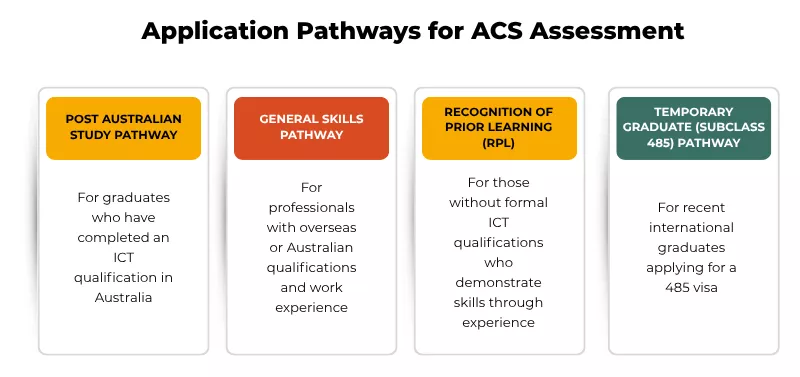
The pathway you choose affects the documents required, how the ACS assessor will review your evidence, and ultimately how your ANZSCO occupation nomination is evaluated. Selecting the wrong pathway is as costly as selecting the wrong occupation code.
Qualification Pathways Under ACS Assessment
ACS occupation assessment guidelines recognise multiple qualification levels, and each is assessed differently in relation to your nominated ANZSCO occupation.
ICT Major Qualifications: Applicants with a Bachelor’s degree or higher in an ICT-major field are generally required to show less supporting work experience. ACS considers the qualification itself as meeting a portion of the skills requirement.
ICT Minor or Non-ICT Qualifications: Applicants whose degree has limited ICT content, or whose degree is in an unrelated field, must compensate with additional years of relevant work experience. Common examples include:
- Self-taught developers or career changers
- Diploma holders in ICT or related areas
- Professionals with engineering, science, or commerce degrees who moved into ICT roles
In all cases, your qualification must still align meaningfully with your nominated ANZSCO occupation. A Computer Science graduate nominating an ICT Security Specialist code, for example, would need to show that their work duties genuinely match that occupation’s requirements, and to align with them, you can only rely on a genuine TheCDRWriter.
Recognition of Prior Learning (RPL Report): A Pathway for Non-ICT Graduates
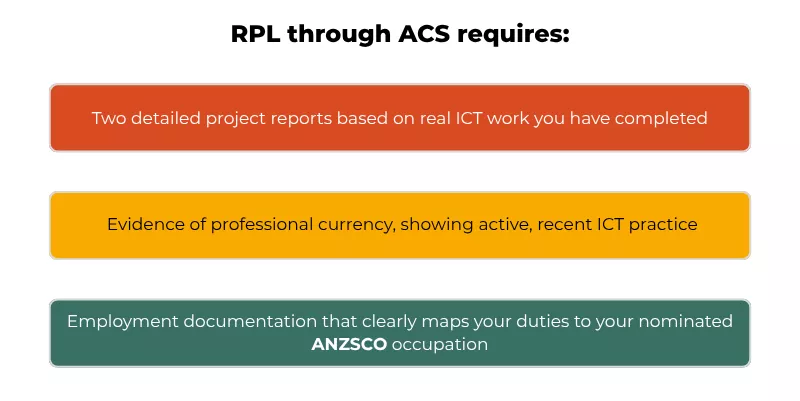
The RPL pathway allows ICT professionals without formal qualifications to demonstrate their skills through documented professional experience. If you are applying via RPL report writing services, your ANZSCO occupation nomination becomes even more important, because everything rests on your work evidence.
RPL through ACS requires:
Work Experience Assessment: What ACS Actually Counts
ACS does not automatically count all of your work experience. Instead, it checks your employment history in two stages:
- Relevance check: Is the work closely related to your nominated ANZSCO occupation?
- Skill level deduction: A period is deducted to reflect the time needed to reach professional ICT competency
Only experience after the deduction period is recognised as skilled for migration points. This surprises many applicants who assume all past employment will count in full.
Why ACS Deducts Experience (And Why This Is Normal)
The skill level deduction is not a penalty; it is standard ACS practice. It reflects the time required to develop professional-level ICT competency after completing your qualification. Typical deductions:
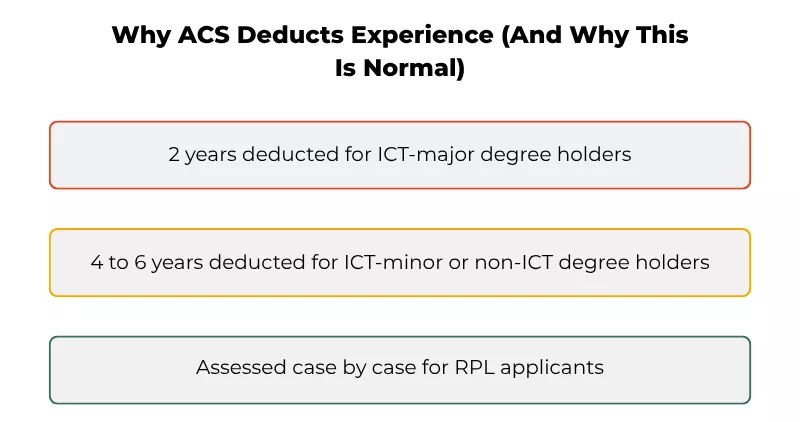
The date ACS determines you became skilled has a direct impact on your migration points score and EOI competitiveness. An applicant with 10 years of experience may find that only 5 to 6 years are recognised, and this is entirely based on the interaction between their qualification pathway and their nominated ANZSCO occupation.
In some circumstances, experience deemed not skilled by ACS has still been accepted by immigration at the visa stage. Each case is assessed independently, so it is worth seeking expert advice if your situation is complex.
How Employment Evidence Influences ACS Outcomes?
ACS will assess the quality and consistency of your occupations in Australia. The evidence should:
- Clearly show specific job duties, not just your title and dates.
- Show that your work aligns with your nominated ANZSCO occupation
- Show full-time work, or part-time work of at least 20 hours per week
- Maintain consistency across all documents.
Why Salary and Role Level Matter Indirectly?
ACS does not set a salary threshold for its assessment. However, your remuneration and career progression can indirectly affect the criteria on how assessors view your application.
Consistent or growing salary levels can help in showing:
- Genuine professional employment at a skilled level.
- Progression and seniority within your ICT role
While salary alone is not the deciding factor, other factors, like inconsistencies for claimed senior ICT roles, can cause issues when assessed as outlined in the ICT occupation.
ACS Assessment Outcomes: What You Can Expect
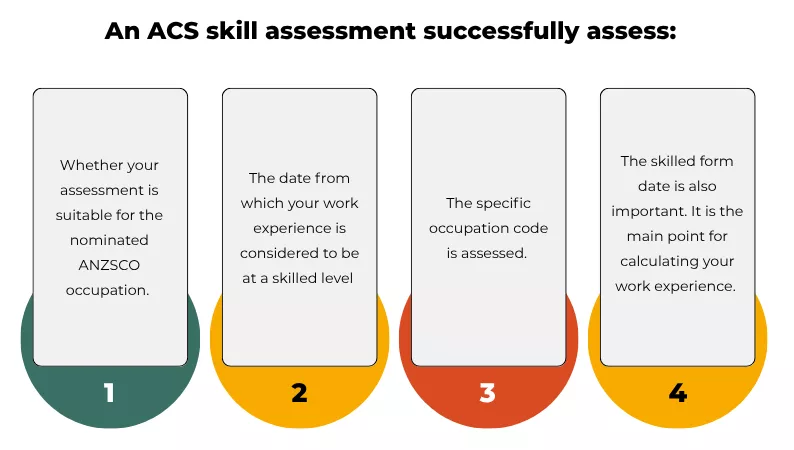
An ACS skill assessment successfully assesses:
What ICT Migrants Must Understand Before Applying?
Before you start or submit your application, it is best to understand what ACS is not looking for.
- It is not looking for your job title or designation
- The brand reputation of your employer
They are looking for:
- The specific task you perform in your nominated ICT role.
- The depth of your ICT skills and their relevance to your ANZSCO occupation
- The quality and consistency of the documentation provided
- Your professional progression over time
- When you understand this beforehand, you save time and money.
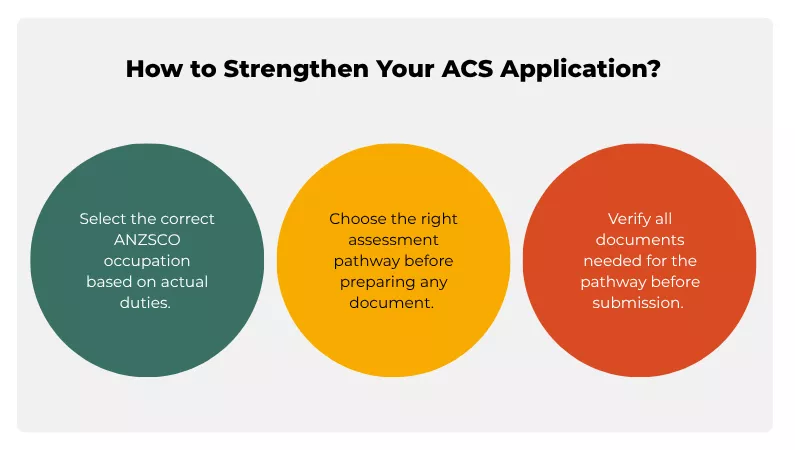
How to Strengthen Your ACS Application?
A well-prepared ACS occupation list improves your chances of a positive outcome. Successful applicants usually:
ACS assessments are costly and time-consuming. A poorly prepared application does not just risk a negative outcome; it requires a fresh submission and additional expense to your migration timeline.
Turning ACS Approval Into PR Success
A positive skill assessment for Australian immigration is just the starting line. Once you have a suitable outcome, it helps in:
- Gaining migration points for work experience in SkillSelect.
- Eligibility to lodge an EOI
- State and territory nomination based on your ANZSCO occupation.
- Employer sponsorship pathways through Subclass 186 and 494.
Conclusion
Your ACS ANZSCO occupation nomination is not something you should rush or treat as a checkbox. A correct nomination backed by strong, consistent documentation gives your PR application the foundation it needs. If you are unsure which ANZSCO code best fits your profile, duties, and responsibilities, or how to structure your employment evidence, consult a registered migration agent before submitting your ACS application. The right advice at this stage pays dividends throughout your entire migration journey.
Frequently Asked Questions
How to choose correct ANZSCO code for ACS assessment?
The best approach is to match your occupation description derived from the occupation list in the ANZSCO framework. When you apply through the skill assessment portal, you enter your skills, and the portal automatically matches them to the occupation.
Does ACS assess job title or job responsibilities?
ACS assessment will note responsibilities, not job titles. The applicants should review the job description for each ANZSCO code and select the most appropriate one.
What happens if the wrong ANZSCO code is selected?
Choosing the wrong code can cause issues for migration purposes. It causes differences between your RPL report and the ANZSCO criteria, which increases the chances of a negative skill assessment result.
Can one ICT role match multiple ANZSCO codes?
Yes, it is possible. ACS accommodates this now. With recent changes, applicants have the flexibility to choose three different ANZSCO codes.
Is ANZSCO nomination mandatory for ACS skill assessment?
Yes, it is mandatory. They check whether your experience align ICT level and is closely related to the nominated ANZSCO occupation.
Can I change ANZSCO code after ACS submission?
No. Once you submit your application, the assessment process will commence, and it will NOT be possible to update your suggested ANZSCO code(s).

Want To See My Profile — Click Here Juhi
- Engineers Australia Fee Increase July 2026 – Why Submit CDR Now? - April 2, 2026
- ACS ANZSCO Occupation Nomination: Complete Guide For ICT Professionals - March 30, 2026
- How to Format a One Page CPD Entry for Engineers Australia? - February 23, 2026