

Are you an ICT professional planning to migrate to Australia and apply for permanent residency (PR)? The ACS Skills Assessment for PR is a crucial step in your entire journey. This assessment evaluates your academic qualifications and work experience to ensure they meet Australian standards, making it a mandatory requirement for skilled migration visas like the Skilled Independent (subclass 189) and Skilled Nominated (subclass 190). In this guide, we’ll explain why the ACS Skills Assessment is key for PR, outline the process, and help you understand how to maximise your chances of success.
What Is the Purpose and Importance of the ACS Skills Assessment for Permanent Residency?
The primary purpose of the ACS assessment is to understand if an individual’s academic qualifications and work experience meet the Australian standards and ACS assessment requirements of the ICT job market. The assessment further ensures that the education and professional experience align with Australian skill standards necessary for skilled migration.
ACS assesses the relevance of the ICT content in an applicant’s academic degree with respect to the occupation. So, if you hold a general science degree with minimal ICT content, your request will be rejected; however, if you can provide extensive work experience in the field, or an RPL (Recognition of Prior Learning), not the CDR report, then it will be approved.
Why ACS Assessment Is Important?
- Required for Skilled Migration Visas – ACS is a mandatory requirement for ICT-related skilled migration visa applications, such as the Skilled Independent Visa (subclass 189) and Skilled Nominated Visa (subclass 190).
- Validates ICT Professional Skills – A successful ACS skills assessment certifies that the applicant genuinely has the skills and qualifications claimed, thus reducing the risk of fraudulent claims.
- Integral to Visa Application – The ACS approval letter acts as a key supporting document submitted within the visa application to the Department of Home Affairs.
- Points for Work Experience and Qualifications – A positive ACS assessment helps the applicant claim points for qualifications and relevant ICT work experience in the skilled migration points system, thereby increasing their chances of visa success.
- Recognition of Prior Learning (RPL) – For applicants without formal ICT qualifications, but who have the necessary work experience, ACS allows them to submit an RPL report to showcase their skills through project reports emphasising real-world ICT contributions. While writing a report might seem straightforward, meeting MSA’s guidelines is crucial. Therefore, RPL writing services are usually the preferred choice of most Engineers!
Needless to say, ACS is an essential assessment for IT and ICT professionals who are considering migrating to Australia and applying for PR. The next section will take you through the guidelines of the ACS migration skills assessment.
The Necessary Guidelines of ACS Migration Skills Assessment in Australian PR
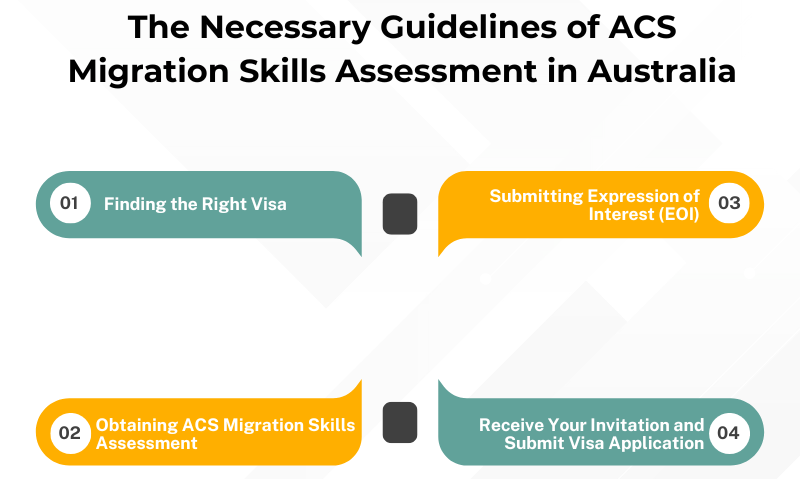
There are a few steps that you need to follow to get employment and permanent residency in Australia. The following steps will help you gain a proper understanding of the ACS migration skills assessment process and ensure visa success:
1. Finding the Right Visa
Professionals seeking employment opportunities and willing to migrate to Australia can apply for three main types of visa:
- Student visas – You can apply for student visas to study IT in Australia. These visas allow international students to stay and attend a registered university or training institution in the country.
- Skilled independent visas – These visas allow IT and data science workers to stay and work in Australia. These do not require sponsorship from an employer or state or territory government.
- Sponsored visas – Australian firm, organisation, or territory/state government that needs IT or data science workers
Once you have decided on the type of visa, move on to the next step to get your ACS migration skills assessment. Check with occupation and ANZSCO, like chemical engineer ANZSCO 233111, to understand the type of visa and apply accordingly.
2. Obtaining ACS Migration Skills Assessment
The ACS migration skills evaluation is an important part of the relocation process. You must follow these instructions to maximise your chances of performing better on the test.
- Right assessing authority – You must ensure that ACS evaluates your occupation before you apply. Also, you must check the ANZSCO codes to ensure they accurately match the qualifications.
- Choose your assessment pathway – You will find several available. It is crucial to select the right pathway to avoid a negative assessment. There are general skills, post-Australian study, temporary graduate 485, and recognition of prior learning.
Each of them has different skills assessment fees. You must also check the fees before selecting the pathway.
- Check your eligibility and prepare your documents – The prerequisites and supporting documents required to participate in each assessment pathway are unique. You must be fully aware of the different documents and complete the online application after confirming your PR eligibility Australia.
You must upload the documents required and links to examples of what they should include. Also, check that the necessary documents are in order. Get the ACS document checklist to arrange things fast.
- Complete and submit your application – The next step is to upload all the completed documents to the ACS portal. To ensure a positive outcome, do not make any mistakes. Also, save your skills test paperwork for your visa application.
- Receive your results letter – Once the application is evaluated, you will get an ACS Outcome Letter indicating the outcome. You need to submit this letter to the Department of Home Affairs (DoHA) to apply for a visa.
3. Submitting Expression of Interest (EOI)
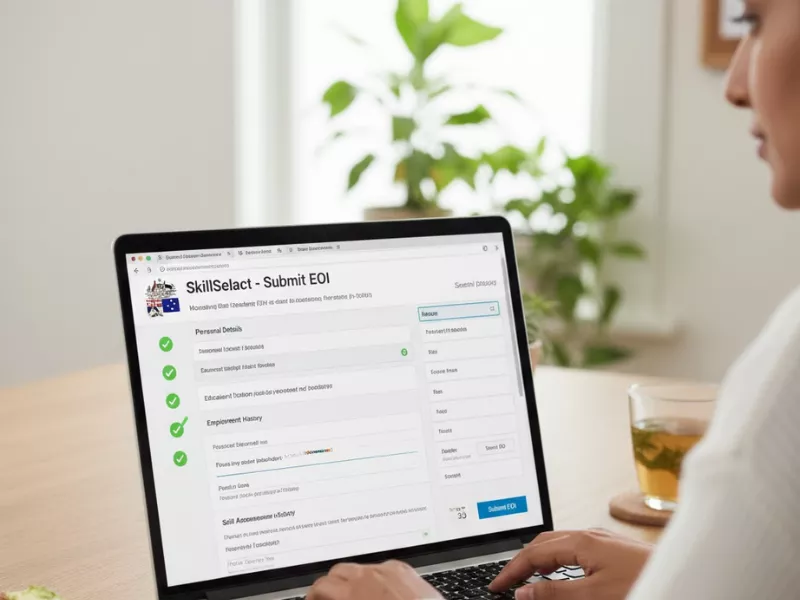
An Expression of Interest is a document that shows interest in a potential job, project, or other opportunity. You need to submit an Expression of Interest (EOI) for your visa to the Department of Home Affairs after a successful ACS skill assessment occupation.
4. Receive Your Invitation and Submit Visa Application
You must first get an invitation from the Department of Home Affairs for the designated visa. After that, you can log in to your ImmiAccount, fill out the form, and submit it. You must also check the processing time for the ACS assessment to get an idea about how long it will take to process your data.
This will help you learn how to apply for ACS skills assessment. You can use the Australian PR point calculator to understand if you are on the right track.
What Are the Documents Required for the ACS Migration Skills Assessment?
It is necessary to submit a specific list of documents to apply for a visa successfully. The following documents are necessary to verify your skills and identity:
A. Personal Identification
- Birth certificate – The document shows your name, birthdate, and father’s name, which is consistent with your citizenship card.
- Passport – Sharing the page with your details will be enough.
- Government-issued IDs – You must submit two IDs (excluding a passport). One of them must have your photo from your birth or home country.
B. Educational Qualifications
- Degree or award certification – Tertiary education (beyond 12th grade) certificate with details like degree title, institution name, and completion time.
- Transcript – Mark sheets showing subjects and grades
C. Work Experience
- Work experience letters – You must submit detailed work experience letters outlining roles, responsibilities, and year of relevant work experience.
D. Additional
- Resume – This is optional, but it is ACS recommended. You must also go through the RPL report writing checklist Australia for a better understanding.
The following section will take you through the four pathways of ACS skills assessment. It will help you better understand your pathway and how you will be evaluated.
The Four Pathways of ACS Skills Assessment
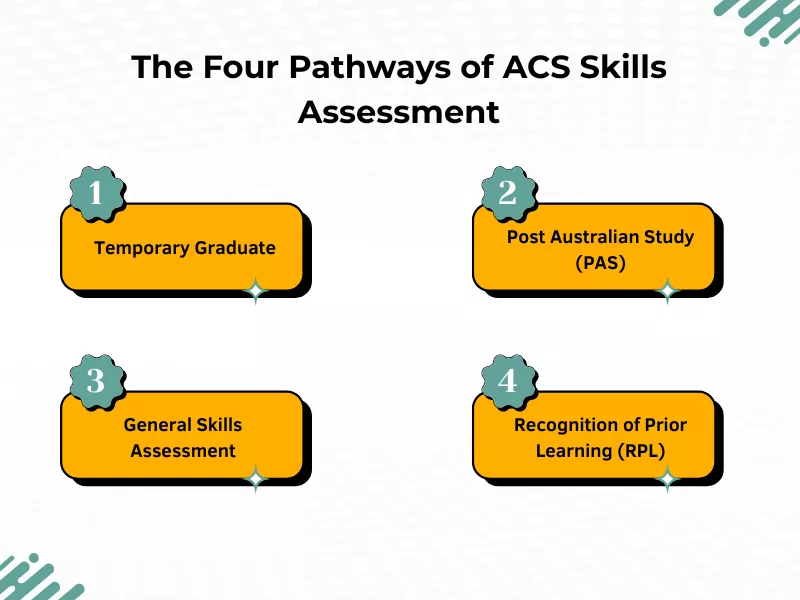
There are four unique pathways provided by the ACS for skills assessment. Each of these pathways caters to different circumstances and individuals within the Information and Communications Technology (ICT) field:
A. Temporary Graduate
This is applicable to Australian Bachelor’s degree holders or higher. The pathway allows recent graduates to confirm their ICT qualifications for post-study employment or migration.
B. Post Australian Study (PAS)
This pathway is also exclusively reserved for Australian Bachelor’s degree holders or those with higher qualifications. It is designed for assisting graduates who have completed their ACS professional year in Australia after getting their degree in the country. The pathway allows these graduates to showcase their ICT qualifications after they complete their studies.
C. General Skills Assessment
This is open for both Australian and international applicants. The pathway of ACS migration skills assessment evaluates a wide range of ICT qualifications and work experiences.
D. Recognition of Prior Learning (RPL)
The pathway is ideal for individuals without formal ICT qualifications, but with enough ICT work experience. It allows individuals to highlight their expertise using a comprehensive skills portfolio submission.
The pathways act as essential tools for applicants. It helps validate the qualifications and skills of individuals with respect to ACS skills assessment and improves their career and migration prospects in Australia. You can check it for Chief Information Officer ANZSCO 135111 to understand how they are evaluated.
You must understand the pathway that is appropriate for you. Ensure you have the required documents, and take some time out to navigate the ACS skills assessment process. Also, go through the ACS skill assessment cost for a better understanding of the process.
Get Expert Help with ACS Skill Assessment Report
We have a team of qualified ACS skill assessment report writers to help you with the process. We understand the importance of the report and ensure you get the right help. You can connect with us to understand what you need for the report and get it written by one of our experts.
Be assured of getting a perfect report written by one of our experts on time. We aim to increase your chances of getting a PR in Australia. We can also help with a CDR for engineering manager ANZSCO 133211.
Final Thoughts,
ACS skills assessment is an important part of the Australian PR, specifically for ICT professionals. For individuals who do not have the necessary ICT qualifications but have the necessary work experience, they can submit an RPL along with their immigration application.
We also suggest you take a look at the Australian PR point calculator to understand the points required for PR. You can connect with TheCDRWriter to get expert tips to apply for the ACS skills assessment.
Frequently Asked Questions
Does the ACS skills assessment require an English language test for PR?
No, the ACS skills assessment does not need an English language test. However, to pass the overall Australian PR process, you’ll need to meet the English language criterion through separate tests as part of the visa subclass 485 or other PR applications.
What are the common reasons for ACS skill assessment rejection for PR?
The common reasons for ACS skill assessment rejection for PR include:
- Incomplete or incorrect documentation
- Insufficient years of experience
- Selecting the wrong ANZSCO code
- Generic reference letters without company letterhead
- Mismatched job duties with the selected
- Failure to handle every step and attention to detail
How long is the ACS skills assessment valid for PR?
Generally, a positive ACS skills assessment is valid for three years. However, it is necessary to check the exact validity period mentioned in your ACS assessment letter. This period has an impact on your selection and preparation for the Australian migration and visa application process.
Can international work experience affect ACS assessment outcomes?
Yes, international work experience can be considered positively if it meets ACS criteria and is well-documented. You must provide evidence of your years of experience in relevant ICT roles, and the experience must clearly connect to the nominated occupation.
What are the ACS skill assessment fees?
The fees for ACS skills assessment vary depending on the type of assessment and the pathway you choose. It is recommended that you refer to the ACS Institute’s official website, as fees can change over time.
How to renew or update the ACS skills assessment for migration and PR?
In case your ACS skills assessment is close to expiration or you have new qualifications/experience to add, you need to go through the ACS process for renewal or updating. The preparation process needs updated documentation, evidence of further work experience, or new qualifications.

Want To See My Profile — Click Here Iqbal
- How to Write Career Episode for Industrial Engineer- ANZSCO 233511 - January 16, 2026
- 8 Top CDR Writing Services for Engineers Australia in 2026 - December 17, 2025
- Why Is ACS Skills Assessment for PR in Australia Important? - November 29, 2025